There is a common idea that custom infrastructure belongs only to large companies, expensive projects or highly complex operations. As if tailoring the cloud were a technical luxury, while buying a ready-made package were always the most economical choice.
In practice, the opposite is often true.
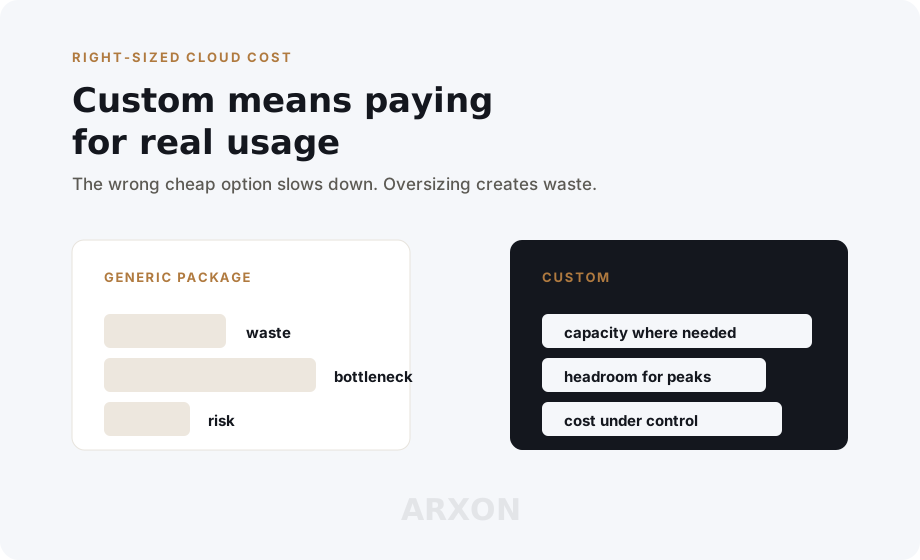
What usually becomes expensive is not well-sized infrastructure. What becomes expensive is the generic package: excess capacity where the company does not need it, missing capacity where the operation is under pressure, and a bill that grows without performance growing with it.
In cloud, paying more does not always mean being safer. Paying less does not always mean saving money. The central question is paying correctly.
Every operation has a usage pattern
Some systems need more processing power. Others depend more on memory. Some have traffic spikes at specific hours. Others need stable storage, low latency, redundancy or higher read and write capacity.
When all of this is treated as if it were the same, infrastructure becomes guesswork. And cloud guesswork becomes recurring cost.
A company may hire larger servers than it needs "just to be safe" and spend months paying for idle capacity. Another may choose a plan that is too cheap and live with slowness, downtime, queues, rework and lost productivity. In both cases, the infrastructure is poorly sized. Only the type of loss changes.
Custom infrastructure starts before the server choice. It starts by understanding the process.
How many people access the system? At what times? Which routines consume more resources? Does volume grow linearly or through spikes? Is there seasonality? Is the database more demanding on reads or writes? Which services must always be available? Which services can scale with demand?
These questions may sound technical, but they are management questions.
The real cost is not only the cloud bill
Infrastructure is not only an IT decision. It affects service, operations, sales, finance, customer experience and business continuity.
A slow system costs time. Downtime costs trust. A poorly planned architecture costs hours of correction. Idle capacity costs money every month.
That is why the number that matters is not only the server price. It is the total cost of operating.
That cost includes the cloud subscription, but it also includes waste, instability, emergency maintenance, rework, slowness, downtime risk, difficulty scaling and team time spent working around problems the architecture should have prevented.
When this calculation is made correctly, custom infrastructure stops looking expensive.
Custom does not mean excessive. It means appropriate. It means placing capacity where there is real consumption, keeping margin where growth is likely and choosing simplicity where there is no need for complexity. It avoids both excess and shortage.
The answer is not always a bigger server
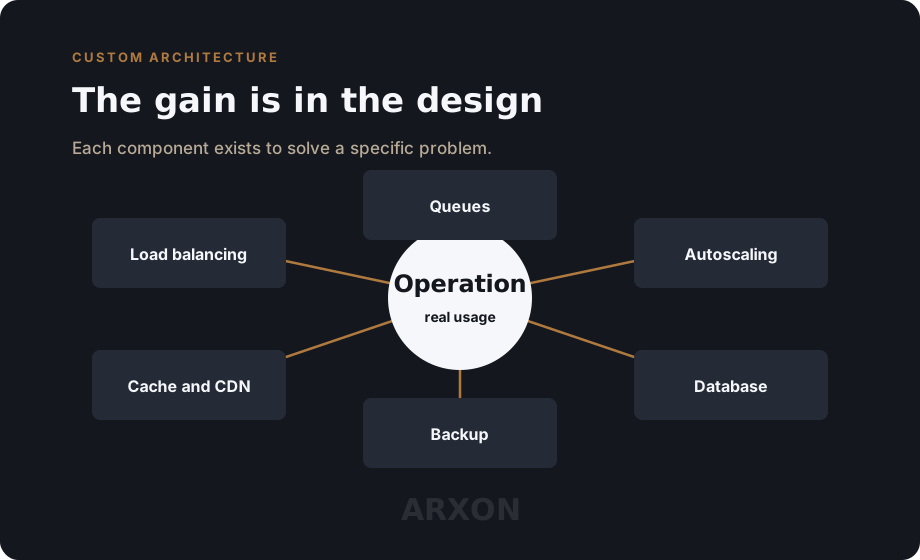
Very often, custom infrastructure does not mean buying a stronger machine. It means designing a better architecture.
One of the best-known strategies is load balancing. It distributes traffic across more than one server. Instead of all requests falling on a single machine, access is divided. This improves performance, reduces downtime risk and allows the operation to grow with more stability.
Another strategy is autoscaling. In this model, infrastructure increases or reduces resources according to demand. If the system receives more access during business hours, the cloud grows during that period. When usage drops, resources decrease. This avoids paying all day for capacity that is only needed at certain moments.
Cache is also important. It stores frequently accessed information to avoid repeated processing. Instead of querying the database every time for the same information, the system serves a prepared version. This reduces cost, improves speed and relieves critical components of the operation.
For static files, such as images, videos, scripts and public pages, a CDN can help. CDN stands for Content Delivery Network. It distributes those files on servers closer to users. As a result, pages load faster, latency drops and the main server does less work.
The database often reveals the bottleneck
Many times, the bottleneck is not in the application, but in the database. That is why a well-designed infrastructure also considers database sizing.
Separating application and database, creating indexes, using read replicas, reviewing slow queries and choosing the right database type can bring more impact than simply increasing server size.
Queues are another important strategy. They allow heavy tasks to be processed in the background, such as sending emails, generating reports, processing files, integrations and notifications.
Instead of making the user wait for everything to happen immediately, the system records the task, puts it in a queue and processes it with control. The user continues using the system, and the operation gains predictability.
Backup and redundancy also belong in the calculation. Backup protects data. Redundancy keeps the service available even when part of the infrastructure fails. This is not technical excess. It is protection proportional to operational risk.
The important point is that every piece has a reason.
Without monitoring, sizing is guessing
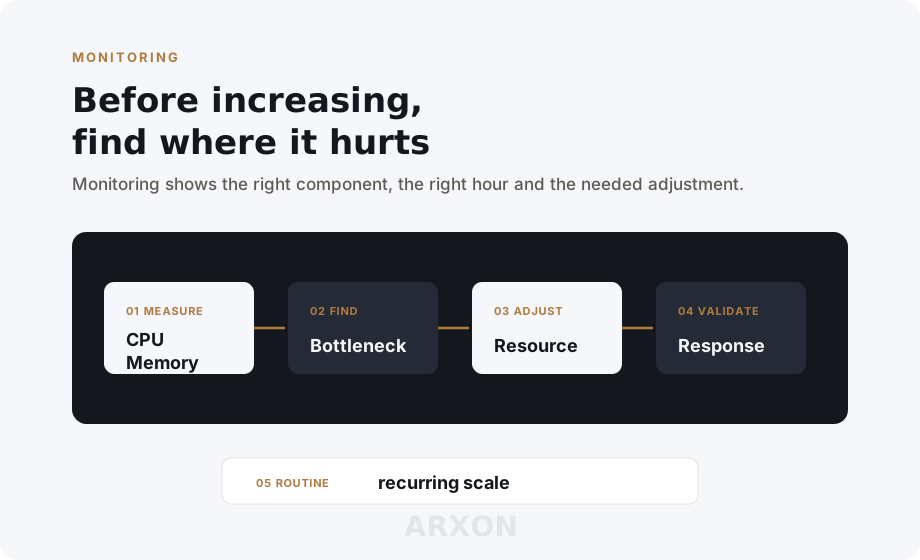
All of this needs to be supported by monitoring. Without monitoring, infrastructure sizing is guesswork.
With monitoring, the company tracks CPU, memory, database usage, response time, errors, traffic, peaks and bottlenecks. The decision stops being "I think we need to increase the server" and becomes "the bottleneck is here, at this time, in this component".
Generic infrastructure is often sold as convenience. At the beginning, it can help. But as the operation grows, the limits appear: slowness without a clear cause, costs that are hard to explain, blind upgrades, trial and error, underused services and persistent bottlenecks.
Custom infrastructure changes this logic. It organizes the cloud around the operation, not the operation around a package.
This makes it possible to spend better. It shows where to reduce, where to reinforce and where to automate. It allows growth without rebuilding everything for every new demand. And it turns cloud from an unpredictable expense into support structure for the business.
The question, then, is not "which server is cheaper?".
The right question is: which infrastructure sustains the operation with the least waste and the lowest risk?
Because cheap, in technology, is not only what costs less on the bill. Cheap is what works, scales and does not charge interest in the form of rework.
Custom infrastructure is not a luxury. It is the fine adjustment between cost, performance and operations. When well sized, it almost always costs less than it seems.
Comments
No comments yet. Start the conversation.