A company decides to modernize its operation. The conversation starts with the system: an ERP, a field app, a dashboard or a platform built in-house.
That conversation often starts too early.
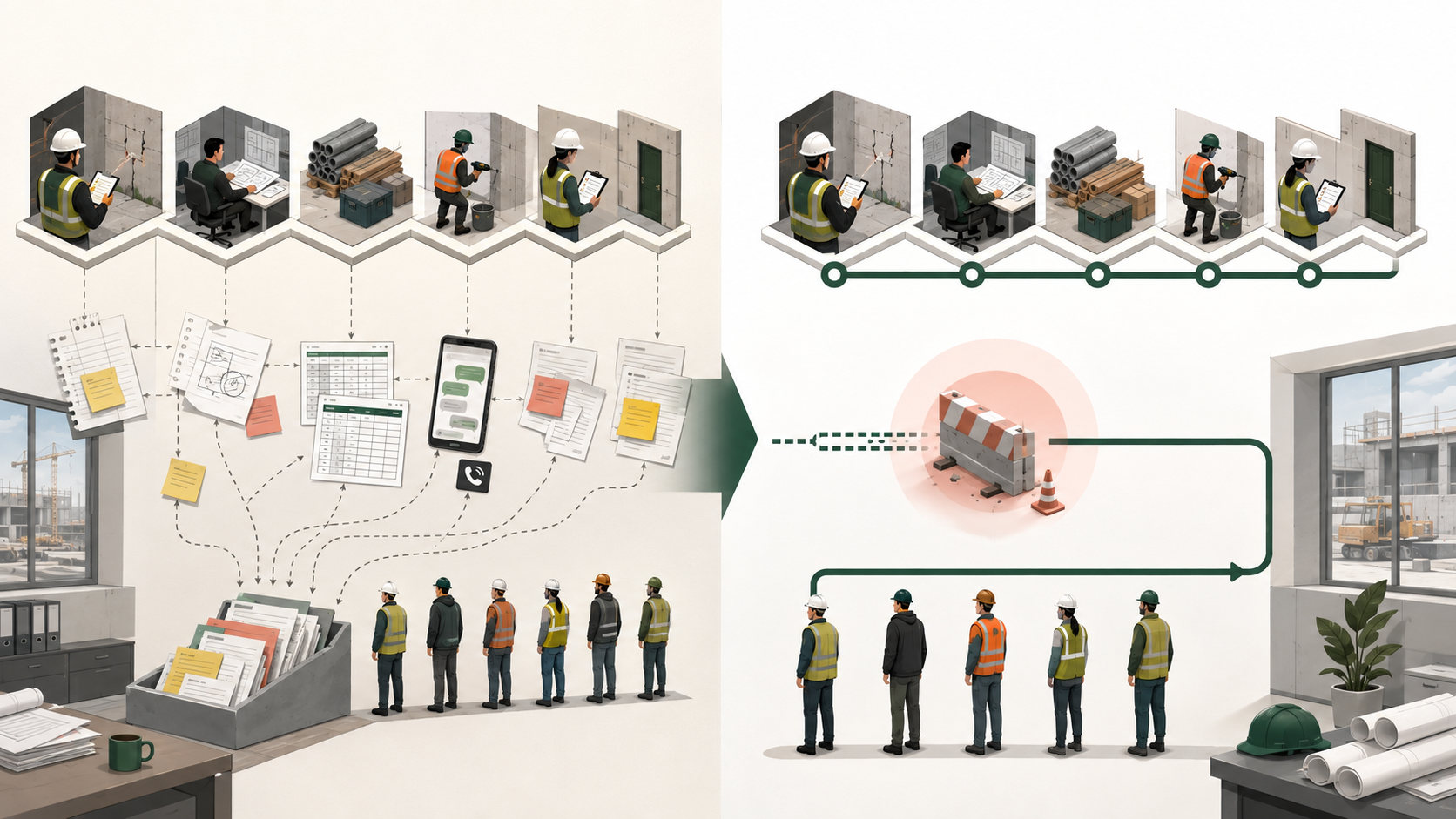
Before choosing a tool, the company needs to understand which operational problem it is solving and how the work should flow. If it simply puts a new screen over a confusing process, it gets digital records while keeping the waiting, rework and unclear ownership.
In construction, this appears in familiar situations: a twenty-minute inspection that waits three days for analysis, material purchased after the activity has started, an approval passed through messages and a request that crosses five departments without a clear owner.
Digitizing records the work. Modernizing changes how the work happens.
Method comes before the tool
Lean, Kanban, the Last Planner System, Agile, BPM and continuous improvement emerged in different settings, but they can answer complementary questions.
Lean asks where waste exists. Kanban makes work and accumulation visible. Last Planner checks whether planned work is actually ready to happen. Agile reduces the time between a change and the response. Business Process Management follows processes across departments. PDCA creates a cycle to test, measure, correct and standardize.
The problem starts when these approaches become rituals. A daily meeting does not make an operation agile. A board with cards does not create flow. A process map on a wall does not improve a process by itself.
The method creates value when it changes a decision: what enters first, who must act, which constraint must be removed and what evidence shows that the change worked.
Lean: measure the entire path
A purchase can take a few hours and still belong to a process that takes ten days. The execution is short; the waiting between stages is long.
This difference stays hidden when each department measures only its own time. Lean shifts attention to the complete flow and to activities that consume resources without moving delivery forward.
Consider a maintenance request: identify the need, register it, analyze it, estimate it, authorize it, purchase, separate, transport, execute, inspect and close it. The useful question is not only how long the team worked. It is how long the request took from identification to completion and where it waited.
This view also avoids a common trap: a team can work faster and still be part of a slow process. The goal becomes making work flow between departments.
Last Planner: plan what can happen
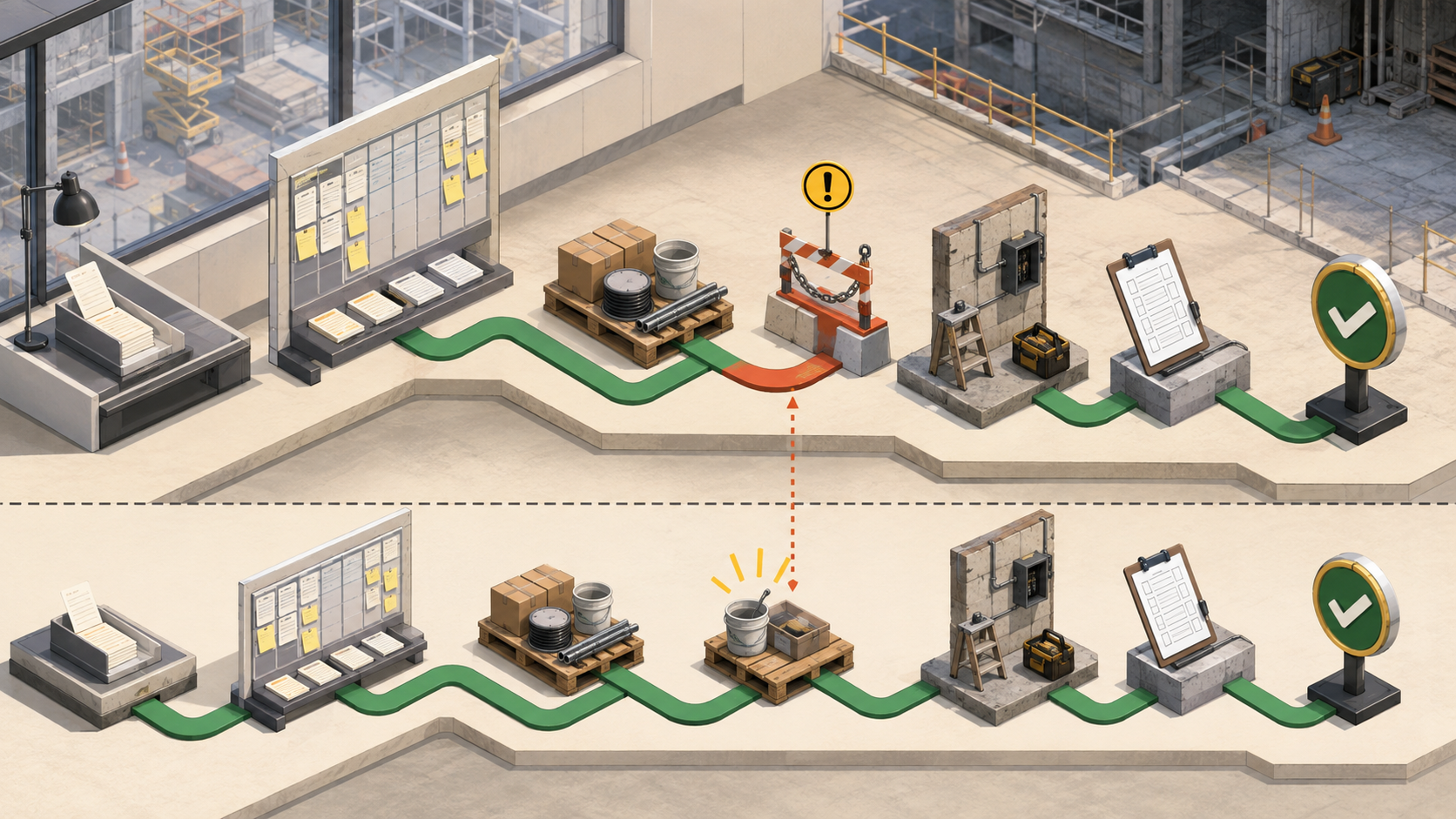
Traditional planning describes what should happen. Last Planner adds an operational question: is this ready to happen?
An activity may be scheduled for Wednesday and still lack material, an approved design, an available crew or a completed predecessor on Tuesday. It exists in the schedule. It is not ready in the field.
The system works with the difference between what should be done, what can be done, what the team commits to do and what was actually completed. This brings planning closer to reality and exposes constraints before they become delays.
A 2024 systematic review analyzed 112 studies on automation in Last Planner System planning and control. It identified 50 functionalities across six stages and highlighted opportunities in constraint management, dynamic replanning and reuse of project knowledge (Agrawal et al., 2024).
A management system should therefore help answer why an activity did not start: material, crew, design, equipment, approval or a dependency on another activity. Showing “late” after the fact is limited. Helping remove the constraint is more useful.
Agility: respond to change without losing control
Change is part of construction operations. A crew member is absent, equipment breaks, material does not arrive, a field condition differs from the plan or a priority changes.
The point is not to eliminate every change. It is to reduce the time between noticing the problem and reorganizing the work.
A systematic review published in the USP journal Gestão & Tecnologia de Projetos analyzed 26 articles on agile management in construction and discussed communication, change management, risk anticipation and hybrid approaches (Enembreck, Freitas and Bragança, 2024).
Applying agility does not mean copying the Scrum process used by a software team. Physical work remains subject to location, safety, materials, equipment, precedence and labor availability. What can be adopted are principles: shorter planning cycles, explicit priorities, frequent reviews, clear responsibility and fast feedback.
In this context, being agile means shortening the interval between change and response. Moving everything faster can simply spread the work.
Scrum and Kanban solve different problems
Scrum can help with project development, system implementation, process improvement, innovation and internal procedures. A backlog, prioritization, short cycles, review and retrospective work when a goal can be organized into increments.
A maintenance operation with hundreds of simultaneous requests may need a different logic. When requests arrive continuously, visual flow and work-in-progress limits may fit better than closed cycles.
Kanban’s value is not the board itself. It is showing how many requests wait for analysis, estimates, material, execution or inspection. If ten enter a stage and six leave, there is accumulation. The system needs to investigate the constraint.
Starting more activities does not mean producing more. Without capacity to finish, the result is partially executed work, divided teams and materials spread across fronts. Being busy is different from creating flow.
BPM: follow the request end to end
Many problems do not belong to one department. A request starts in the field, goes through engineering, moves to procurement, involves finance, returns to logistics and only then reaches the execution crew.
If every department sees only its own stage, nobody follows the whole process. Business Process Management (BPM) treats processes as elements that need to be identified, designed, measured and continuously improved.
This distinction matters. Procurement can improve its internal lead time, engineering can organize its controls and finance can speed up approvals. The request can still take too long if the handoffs remain unclear.
A 2024 critical review of process modeling, management and mining in construction concluded that the sector has room to advance in data-oriented redesign and proposed a process view to support improvement, monitoring and automation (Martinez Lagunas and Nik-Bakht, 2024).
Systems already record requests, status changes, purchases, approvals, travel, inspections and completion. Those events can reconstruct the real path of a request and show where the operation stops. A report that only counts events describes the past; a well-observed process helps decide the next move.
Continuous improvement: implementation is the beginning
A company maps the process, implements the system, publishes the procedure and closes the project. Months later, exceptions, shortcuts and new priorities appear. The flow that worked stops working.
Operational modernization therefore needs a cycle. Plan the change, run it, measure the result, compare it with expectations, correct it and standardize when it makes sense. Then observe again.
This logic changes how technology is built. Instead of trying to predict every situation in one huge system, the company can digitize a flow, observe its behavior, measure waiting and evolve the solution based on real work.
Method organizes the work. Technology records and connects the stages. Data shows what happened. Continuous improvement uses that evidence to adjust the process.
Five questions before buying a system
Before starting an implementation, answer:
- Which request must the process take from beginning to end?
- Where does the request wait, go back or get redone?
- Which constraints prevent the next stage from starting?
- Which decision must the system support, and who can make it?
- What evidence will show, in a few weeks, that the flow improved?
If these answers are unclear, the technology purchase is ahead of the operation.
Construction does not need to choose a methodology for prestige. It needs the lens that helps solve the current problem: flow for waste, limits for excess work, constraints for planning, agility for change, end-to-end visibility for cross-department processes and learning cycles for recurring problems.
Technology creates value when it amplifies an operating model that was designed to work.
Sources
- Moving toward lean construction through automation of planning and control in last planner system: A systematic literature review, Developments in the Built Environment, 2024.
- Explorando o potencial da gestão ágil na indústria da construção: uma revisão sistemática da literatura, Gestão & Tecnologia de Projetos, USP, 2024.
- Process Mining, Modeling, and Management in Construction: A Critical Review of Three Decades of Research Coupled with a Current Industry Perspective, Journal of Construction Engineering and Management, 2024.
Comments
No comments yet. Start the conversation.