Every change in management starts when someone realizes that decisions based only on opinion are no longer enough. In many organizations, decisions still come from habit, urgency or the perception of the person who speaks the loudest. The problem is that guesswork may feel fast, but it often creates rework, waste and low predictability.
Building data-driven management does not mean turning everything into numbers or ignoring the experience of leaders. It means using evidence to make better decisions. Data does not replace human judgment. It improves that judgment, helps separate perception from reality, reveals patterns, exposes bottlenecks and shows whether an action actually worked.
An indicator starts with a management question
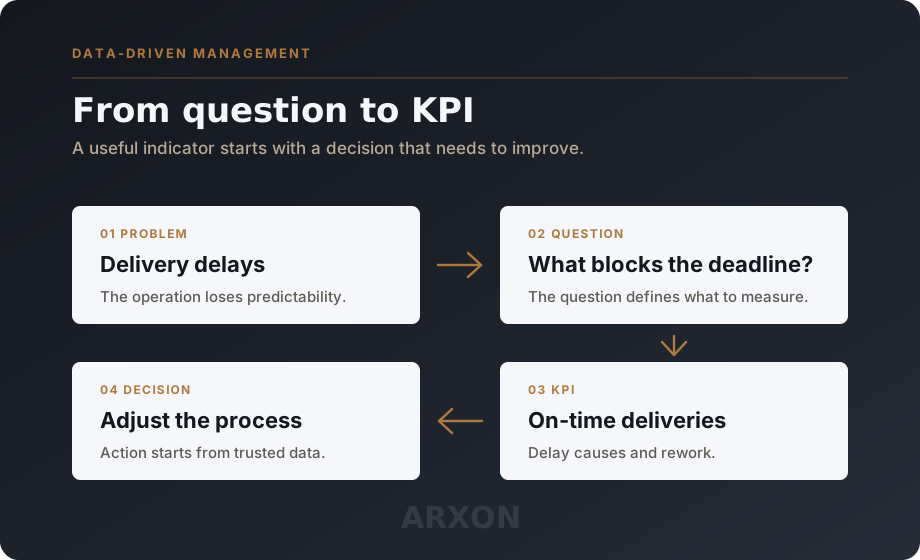
The first step in implementing indicators is understanding that an indicator does not start in a spreadsheet. It starts with a management question.
Before asking "which numbers should we track?", ask: "what do we need to improve?". It may be deadlines, cost, productivity, quality, customer service, sales, customer satisfaction, internal climate or team performance.
If there is no decision to improve, the indicator becomes decoration in a report. It appears on the dashboard, but it does not change the conversation. The meeting remains based on explanations, loose perceptions and daily urgency.
That is why the starting point should be simple. Choose one area, one process or one relevant problem. If the biggest difficulty is delivery delays, start there. Measure the planned deadline, the actual deadline, the number of deliveries completed on time, the main causes of delay and the amount of rework.
You do not need to measure everything at once. Trying to measure everything at the beginning usually creates noise, not clarity.
KPIs need to be few, clear and comparable
KPI stands for Key Performance Indicator. In practice, it is an indicator used to monitor something important for the operation or the company's strategy.
Good KPI management starts with a small set of indicators, clearly defined and reviewed regularly. Three to five relevant KPIs can generate more learning than dozens of confusing metrics. What matters is that each KPI answers a question and supports a decision.
A good KPI must be clear, measurable, relevant, comparable over time and possible to influence through concrete actions. A number that no one can explain, update or improve should not be treated as a KPI.
It is also essential to define exactly what each indicator measures. Many organizations use the same names for different things, which weakens trust in the data. For each KPI, document:
- indicator name;
- objective;
- calculation formula;
- data source;
- update frequency;
- owner;
- target or expected range;
- expected action when the result moves out of range.
An indicator such as "average response time", for example, must make clear whether it measures time to first contact, time to final resolution or time to customer follow-up. Without that definition, two teams can discuss the same name while looking at different realities.
OKRs connect direction, priority and execution
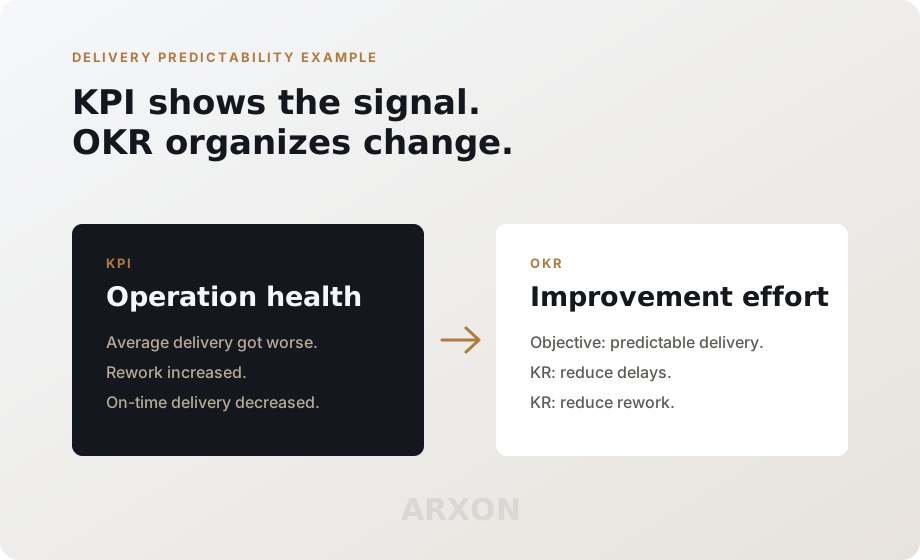
KPIs help monitor the health of the operation. OKRs help organize change.
OKR stands for Objectives and Key Results. The objective describes the direction the company wants to move toward. The key results define how the team will know whether there was real progress.
An objective could be "improve delivery predictability". The key results could track fewer delays, more deliveries completed on time and less rework. The point is not to create polished goals for a presentation. The point is to align the team around clear priorities.
The difference matters. A KPI can show that the average delivery deadline got worse. An OKR can organize the response to that problem during a work cycle. The KPI shows the signal. The OKR guides the improvement effort.
When KPIs and OKRs work together, management stops looking only at what happened and starts creating a routine to improve what matters. KPIs show reality. OKRs help define focus, owner, deadline and evidence of progress.
Before the dashboard, build trust in the data
Without standardization, data loses strength. And when people do not trust the data, management returns to opinion.
Before thinking about sophisticated dashboards, the organization needs reliable records. Where will the information be recorded? Who will be responsible for filling it in? When should the record be created? Which fields are mandatory? How will errors be corrected?
At the beginning, a well-structured spreadsheet may be enough. The most important thing is not to start with the most expensive tool or the most beautiful panel. The most important thing is to build discipline.
A simple spreadsheet, filled in correctly and reviewed often, can generate more value than a complex system that no one feeds properly. Technology should strengthen the management routine, not hide the lack of one.
An indicator only becomes management when it leads to action
Once data starts being collected, it needs to become part of the management routine. An indicator is not decoration. It should be reviewed in recurring meetings, with a focus on learning and action.
Operational indicators may be reviewed weekly. Strategic indicators may be reviewed monthly. What matters is having a clear cadence.
In these meetings, the conversation should not stop at "what was the number?". Leadership needs to ask better questions:
- did the result improve or get worse?
- why?
- what is the likely cause?
- what will we do from here?
- who will be responsible?
- by when?
- how will we know whether the action worked?
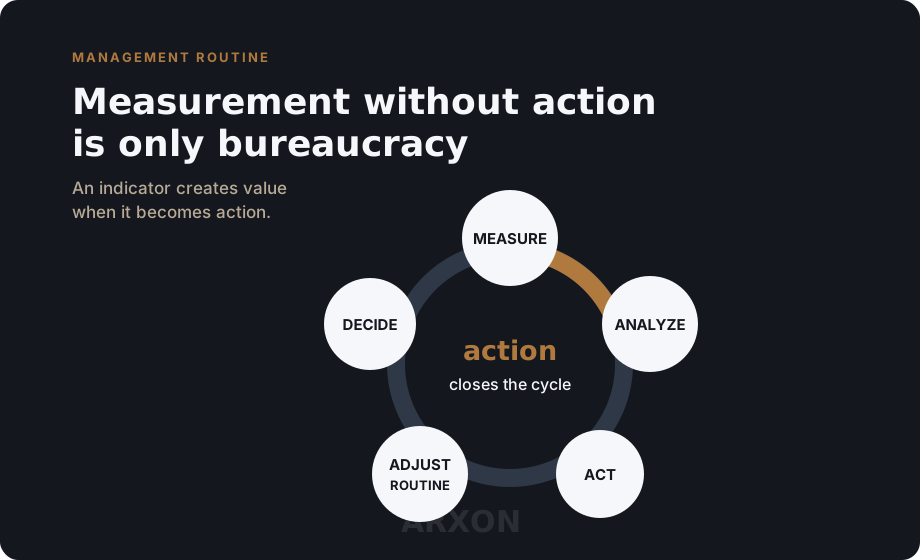
This is where an indicator becomes management. Measuring without acting is only bureaucracy. The right cycle is to measure, analyze, act, follow up and adjust.
If delivery time increased, the team needs to investigate bottlenecks, review processes, redistribute work or align deadlines better. If rework increased, it may be necessary to create checklists, review quality standards or train the team. If customer satisfaction fell, it may be time to listen to complaints, identify patterns and correct recurring failures.
Data should not become a punishment tool
Implementing indicators also requires care in how the team is involved. Many people may interpret data as a tool for punishment or surveillance. That is why leadership needs to communicate the purpose of the change clearly.
Indicators should not exist to chase people. They should exist to improve processes, decisions and results.
That does not mean ignoring individual performance. It means starting the analysis with the system. Does the team have the right resources? Is the process clear? Is demand balanced? Are there communication gaps? Is training missing? Are the tools insufficient?
When management uses data with maturity, it becomes fairer because it reduces judgments based only on personal perception.
Still, it is important to remember that data does not speak by itself. It shows signals, but it needs interpretation. A number may indicate a drop in productivity, but it does not explain by itself whether the cause is excess demand, low motivation, process failure, lack of training or a technology problem.
Data needs to move together with listening, context and critical analysis.
Culture comes before the tool
Starting data-driven management is, above all, building a new culture. It means replacing ready-made answers with better questions. It means moving from "I think" to "what does the data show?".
And when the data does not exist yet, the question should be: "what do we need to start recording so we can make a better decision next time?".
The change does not happen overnight. It requires consistency, method and leadership commitment. But the path can be simple: choose an important process, define the objective, select a few KPIs, standardize the record, review the results in a fixed routine and use OKRs when a clearer improvement effort is needed.
In the end, data-driven management is not born from a sophisticated dashboard. It is born from the discipline of measuring better, interpreting better and deciding better. Technology can help, but culture comes first.
When the organization learns to combine experience, evidence and action, guesswork loses space and results start being built with more clarity, fairness and consistency.
Comments
No comments yet. Start the conversation.